New York, USA, April 15, 2026 (GLOBE NEWSWIRE) -- Generalized Myasthenia Gravis Market on the Brink of Change: 8 Promising Late-Stage Drugs Signal a New Treatment Era | DelveInsight
The generalized myasthenia gravis treatment pipeline features several promising late-stage candidates, including IMVT-1402 (Immunovant/Roivant Sciences), Descartes-08 (Cartesian Therapeutics), Remibrutinib (Novartis), FABHALTA (Iptacopan) (Novartis), Gefurulimab (Alexion AstraZeneca Rare Disease), MAVENCLAD (Cladribine) (Merck KGaA), Telitacicept (RemeGen), Pozelimab + Cemdisiran (Regeneron Pharmaceuticals), along with other emerging therapies advancing through clinical development.
Generalized myasthenia gravis (gMG) accounts for nearly 70% of all myasthenia gravis cases, driven primarily by autoantibodies targeting the acetylcholine receptor (AChR) or muscle-specific tyrosine kinase (MuSK), key players in neuromuscular signaling.
Treatment has evolved from traditional cholinesterase inhibitors and immunosuppressants to advanced targeted biologics, including ULTOMIRIS and VYVGART (along with VYVGART HYTRULO/VYVDURA). Acute interventions like plasmapheresis and IVIG remain critical for severe cases, while thymectomy continues to play a role in select patients.
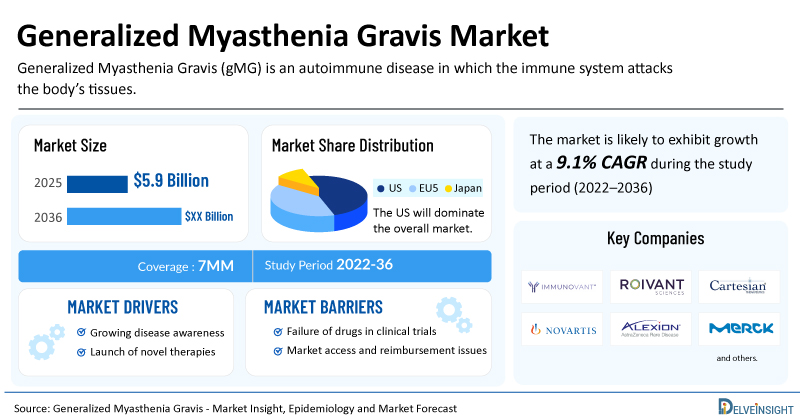
Reflecting this momentum, the gMG market across the 7MM was valued at USD 5.9 billion in 2025 and is projected to grow at a robust CAGR of 9.1% through 2036, driven by expanding biologic adoption, better diagnosis rates, and broader patient access.
Discover how big is the generalized myasthenia gravis market forecast @ https://www.delveinsight.com/sample-request/generalized-myasthenia-gravis-gmg-market
Despite these advances, significant unmet needs remain, particularly in achieving rapid disease control and long-term remission in refractory patients. This gap is fueling demand for next-generation therapies offering faster onset, sustained efficacy, and improved safety profiles across disease stages. Below, we highlight 8 late-stage gMG therapies poised to reshape the future of gMG management.
Immunovant/Roivant Sciences’ IMVT-1402
FcRn antagonists
IMVT-1402 is an advanced, subcutaneously delivered anti-FcRn monoclonal antibody being developed by Immunovant to treat IgG-driven autoimmune diseases. It reduces harmful IgG levels while maintaining normal albumin and cholesterol, helping to address safety concerns associated with earlier FcRn inhibitors. As Immunovant’s primary asset, IMVT-1402 is progressing through clinical trials in indications such as myasthenia gravis and other autoimmune conditions. The company has chosen not to seek regulatory approval for batoclimab in myasthenia gravis, instead leveraging insights from its clinical development to accelerate and inform the advancement of its next-generation candidate, IMVT-1402.
Sadaf Javed, Manager of Forecasting and Analytics at DelveInsight, commented that IMVT-1402 emerges as a strategically important and clinically promising asset in Immunovant’s pipeline, with the potential to set a new standard in FcRn inhibition by combining potency with a clean safety profile, critical factors for long-term success in autoimmune indications.
RemeGen/Vor Bio’s Telitacicept
BLyS/APRIL dual-target fusion protein
Telitacicept (RC18) is an innovative fusion protein developed to inhibit key drivers of B-cell activity in autoimmune disorders. It integrates the Transmembrane Activator and CAML Interactor (TACI) receptor with the Fc region of human IgG, enabling it to simultaneously block BLyS and APRIL, two cytokines essential for B-cell survival and autoantibody generation. By modulating these pathways, Telitacicept helps suppress aberrant B-cell responses and supports more comprehensive disease management.
As the first-in-class therapy to concurrently target both BLyS and APRIL, Telitacicept represents a novel approach to controlling B-cell function. It is currently undergoing Phase III clinical evaluation for generalized myasthenia gravis (gMG) and has already been approved in China for this indication, marking a significant global milestone as the first treatment to address both pathways in gMG.
Explore what are the emerging therapies in gMG and their market impact @ Emerging Therapies in gMG Market
Novartis’ FABHALTA
CFB inhibitor
Iptacopan (LNP023) is an orally available small-molecule therapy designed to inhibit the complement system, a key contributor to inflammation and autoimmune disease processes. It works by selectively blocking Factor B, an essential component of the alternative complement pathway, thereby preventing the formation of C3 and C5 convertases. This action halts downstream complement activation, helping to minimize immune-driven tissue injury and cell damage. The drug is marketed as FABHALTA and is already approved for another indication. Novartis is expected to submit Phase III data for generalized myasthenia gravis (gMG) by 2027.
Javed said that with its oral administration and potential applicability across a range of complement-mediated conditions, Iptacopan may establish a distinct position in the gMG treatment landscape, particularly for patients who do not achieve adequate control with current therapies.
Alexion AstraZeneca Rare Disease’s Gefurulimab
C5 inhibitor
Gefurulimab (ALXN-1720) is an investigational, humanized bispecific VHH antibody engineered to bind both complement protein C5 and albumin, and is optimized for subcutaneous administration. It is currently being developed for the treatment of gMG and proteinuria. Through its anti-C5 component, gefurulimab selectively binds to terminal complement protein C5, inhibiting activation of the terminal complement pathway and thereby reducing complement-driven inflammation and cell destruction.
Since uncontrolled complement activation is implicated in multiple autoimmune and inflammatory disorders, its inhibition may help prevent tissue damage. Additionally, its albumin-binding domain extends the molecule’s half-life, supporting sustained therapeutic activity. Recent pipeline updates indicate that gefurulimab has progressed into the regulatory review stage, with its first major market application already submitted, positioning it as a potential emerging competitor in the gMG treatment landscape.
To know more about emerging FcRn therapies to reshape gMG treatment landscape, visit @ Generalized Myasthenia Gravis Medication
Regeneron Pharmaceuticals’ Pozelimab + Cemdisiran
Complement C5 inhibitor
Poze-Cemdi is an innovative dual-acting therapy that targets complement component C5 through two complementary mechanisms, making it a first-of-its-kind approach. Pozelimab, a fully human monoclonal antibody, directly blocks C5 activity, while cemdisiran, an investigational siRNA therapy, reduces circulating C5 levels by suppressing its gene expression. Together, these agents are designed to provide a synergistic inhibition of the C5 pathway. Both pozelimab and cemdisiran are currently being studied in separate Phase III clinical trials across multiple complement-driven conditions, including myasthenia gravis.
Novartis’ Remibrutinib
BTK inhibitor
Remibrutinib (LOU064) is an investigational therapy and a highly selective, covalent oral inhibitor of Bruton’s tyrosine kinase (BTK). It is designed to regulate B-cell signaling and downstream immune responses that play a central role in the pathophysiology of gMG. The drug is currently in Phase III clinical development for this indication. By inhibiting the BTK signaling pathway, remibrutinib aims to alleviate key disease symptoms.
According to recent updates from Novartis, regulatory submission is not anticipated before 2028. Its oral formulation represents a meaningful advantage over existing intravenous (IV) or subcutaneous (SC) therapies, with the potential to enhance patient adherence and lower healthcare system burden. As interest in BTK inhibitors for autoimmune diseases continues to grow, remibrutinib could emerge as a novel therapeutic option in gMG, assuming Phase III trials confirm favorable efficacy and safety outcomes.
Ramandeep Singh, Senior Consultant of Forecasting at DelveInsight, said, its late-stage development timeline and the increasingly competitive landscape, featuring FcRn inhibitors, complement inhibitors, and other biologics, may pose challenges to market uptake. If successful, however, remibrutinib’s convenient oral dosing and differentiated mechanism of action could position it well, particularly among patients seeking targeted, steroid-sparing treatment alternatives, as per Singh.
Find out more about which drugs will gain maximum market share in gMG @ Generalized Myasthenia Gravis Drug Treatment
Cartesian Therapeutics’ Descartes-08
RNA CAR T-cell therapy
Descartes-08 is an innovative RNA-engineered CAR-T (rCAR-T) therapy being developed for myasthenia gravis and other autoimmune conditions. In contrast to conventional DNA-based CAR-T approaches, this RNA-based platform enables more controlled and predictable pharmacokinetics while avoiding the risk of genomic integration, potentially improving its safety profile. The therapy is autologous and personalized, involving the collection of a patient’s own cells, their modification using RNA, and subsequent reinfusion in an outpatient setting. The treatment regimen includes six weekly infusions. The program is currently funded to continue operations through the completion of its Phase III study in myasthenia gravis, with support expected to last until mid-2027.
Having received RMAT and Orphan Drug Designations, and with its Phase III AURORA trial progressing under the FDA’s Special Protocol Assessment, Assistant Project Manager, Forecasting at DelveInsight, said that Descartes-08 is emerging as a promising first-in-class, durable, and patient-convenient cell therapy for generalized myasthenia gravis. If clinical outcomes are favorable, it has the potential to reshape the autoimmune neurology landscape by addressing the need for safer, longer-lasting, and more patient-friendly treatment options.
Merck KGaA’s MAVENCLAD
Cytotoxic effects on B and T lymphocytes
Cladribine, marketed as MAVENCLAD, is an oral treatment candidate for generalized myasthenia gravis (gMG). It is thought to selectively reduce B and T lymphocytes-immune cells that produce harmful autoantibodies driving inflammation at the neuromuscular junction. Owing to its targeted mode of action and short, at-home oral dosing schedule, cladribine has the potential to slow disease progression while easing the overall treatment burden.
As per Thakur, initial findings from small, treatment-refractory cohorts indicate promising symptom improvement; however, regulatory approval will depend on outcomes from pivotal trials, anticipated around mid-2028. If these trials are successful, Thakur said, cladribine may emerge as a differentiated and more patient-convenient option compared to burdensome parenteral immunosuppressants, particularly appealing for individuals with gMG who prefer less frequent, at-home dosing.
Discover more about gMG drugs in development @ Generalized Myasthenia Gravis Clinical Trials
Source: Generalized Myasthenia Gravis Market Report
Generalized Myasthenia Gravis Market Insights, Epidemiology, and Market Forecast – 2036 report delivers an in-depth understanding of the disease, historical and forecasted epidemiology, as well as the market trends, market drivers, market barriers, and key gMG companies, including UCB, Johnson & Johnson, Amgen, Immunovant, Roivant Sciences, Cartesian Therapeutics, Novartis, Alexion AstraZeneca Rare Disease, Merck KGaA, RemeGen, Regeneron Pharmaceuticals, argenx, Kyverna Therapeutics, NMD Pharma, Dianthus Therapeutics, Cabaletta Bio, COUR Pharmaceutical, ImmunAbs, Flerie, Toleranzia, Arcellx, Bristol-Myers Squibb, Ahead Therapeutics, Biohaven, and others.
About DelveInsight
DelveInsight is a leading Business Consultant and Market Research firm focused exclusively on life sciences. It supports pharma companies by providing comprehensive end-to-end solutions to improve their performance. Get hassle-free access to all the healthcare and pharma market research reports through our subscription-based platform PharmDelve.

Contact Us

Shruti Thakur

info@delveinsight.com

+14699457679

www.delveinsight.com